

The defining advantage of the AI era will not belong to the company with the most capable agents. It will belong to the company that designs the strongest relationship between agents, systems, and humans.
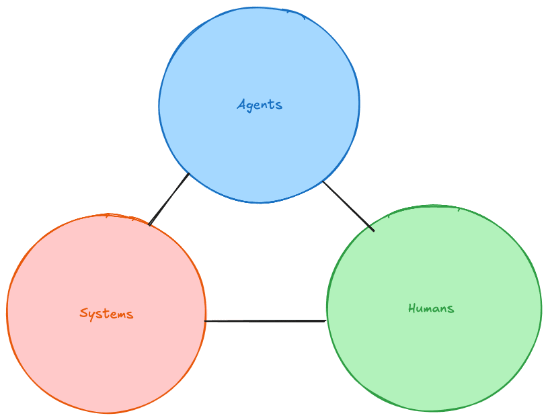
Each contributes something the others cannot. Systems provide consistency through deterministic rules and fixed logic. Agents navigate ambiguity, working across information that is too vast and changes too quickly for hard-coded rules. Humans exercise judgment, take ownership, and accept responsibility.
Each has limits. Systems are rigid. Agents can be unpredictable. Human attention is scarce. With clear boundaries and intentional handoffs they can create an organization that does more without becoming reckless and scales without losing accountability.
This relationship is becoming the foundation of AI first Sales Team. The central question is no longer simply, “What can we automate?” It is, “Which actor should own each part of the work?”
Systems should own repeatability. If something must happen the same way every time, remain explainable, and be auditable, it belongs in the system. Identity and deduplication, routing and ownership, pricing and approvals, and stage transitions all depend on explicit rules. The system establishes what is true, what is permitted, and what happens next.
Agents should own preparation. They are most useful when the inputs are large, messy, unstructured, and constantly changing. An agent can enrich an account, research its context, summarize the available evidence, draft a brief, and recommend a next action. Its role is to turn complexity into something a person can evaluate—not to quietly absorb responsibility for the decision.
Humans should own consequential decisions. A person accepts or rejects a recommendation, sends the external message, approves the commercial terms, or overrides the standard process with a recorded reason. Keeping a human in this position is not a failure of automation. It is a deliberate assignment of accountability.
This model also reveals where many AI implementations go wrong. Companies often treat an agent as if it were a system: they ask it to determine the source of truth, interpret policy, and execute an irreversible action in one opaque step. The result is a black box with no owner when something fails.
The opposite approach fails too. Forcing every ambiguous situation into deterministic logic creates brittle workflows and an endless burden of maintaining rules. Requiring a human at every step preserves control, but leaves people sorting through information that machines could have prepared for them.
The better operating model gives each actor the work it is best equipped to perform: put certainty into systems, ambiguity in the hands of agents, and consequential judgment with humans. Automate preparation aggressively. Automate execution selectively. Preserve human ownership wherever an action is difficult to reverse, externally visible, or strategically meaningful.
These boundaries will evolve as agents become more capable and organizations learn which decisions can be made repeatable. But ownership will not become less important. It will become the core design problem.
The companies that win with AI will not necessarily be the ones that automate the most. Define, build and continue to change this relationship.
Systems enforce. Agents prepare. Humans decide and own.
For now...